
Our firm began practicing fractional sales management in early 2006, and nearly 20 years later, in 2025, we have continued with little modification from its origins. We didn’t create the term, but we are part of the history of a once hard-to-fill role that has emerged.
Fractional Sales Management is the practice of an experienced sales leader, “The Fractional Sales Manager,” sharing their leadership time across multiple small-business sales teams.
A fractional sales manager is an alternative to hiring a full-time sales manager, providing small businesses with a lower staffing cost while adding a highly skilled manager to lead the sales department. A fractional sales manager will take on full accountability, like a full-time manager, for hiring, performance management, compensation, process development, CRM strategy, reporting, goal setting and attainment, coaching, and team and individual growth. The innovation of Fractional Sales Management has moved past the innovator stage and into the early adopters.
How Fractional Sales Management Helps Small Businesses Break Through Sales Plateaus
Fractional Sales Management solves a common challenge facing small business owners, impeding their ability to scale business growth. These companies have plateaued or hit a sales ceiling. The effort, strategies, and salespeople that have propelled them to their current sales volume are no longer enough to achieve higher sales. Hiring a quality sales manager is the obvious solution, but finding one can seem nearly impossible for most small businesses. Not just hiring any sales manager or promoting a top salesperson in hopes of magic, but finding a qualified sales management professional who will accept and embrace the role is the challenge fractional sales managers are now solving. Later in this article, you’ll learn why finding a quality sales manager is difficult.
Without a professional sales manager providing “sales leadership,” sales teams are often left alone or managed by the business owner. Most owners do not possess the experience, time, or know-how to scale up a sales department. Some owners are skilled at selling, but hiring and developing other salespeople is not their strength. Underestimating the value of a sales leader who will bring out the best in salespeople and create a culture that will attract better talent will often prolong plateaued sales levels.
What Is a Fractional Sales Manager?
A fractional sales manager provides high-level sales management and leadership to a small business at a monthly expense that is often less than half of what a full-time sales manager would cost. Fractional Sales Managers simultaneously share their time and talents with a handful of companies and sales teams.
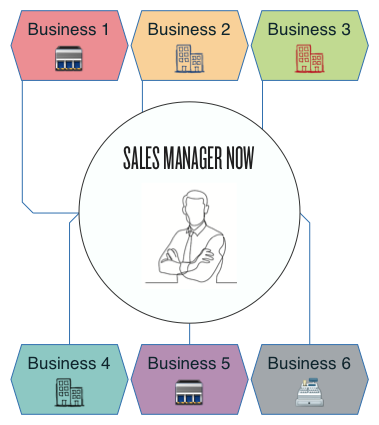
The term fractional is associated with two factors. The sales management professional provides a fraction of their time, and a small business pays a fraction of that manager’s overall compensation. When you hire a fractional sales manager, you should work with them as your sales manager. You hire a professional to lead and manage the salespeople and represent the sales team at the company leadership level.
Before Fractional Sales Management became popular, our company referred to this approach as Shared Virtual Sales Management. We used the term virtual because that is our model. As a corporate sales manager, I managed teams across a vast geographic territory, so it made sense to apply the same approach to smaller company sales teams. We worked virtually before the COVID-19 pandemic pushed many businesses to embrace the technology. Not all fractional sales managers work virtually—some work close to home to meet clients face-to-face.
The focus is on small businesses because medium and large enterprises often reach a point where a full-time manager makes the best sense.
I can’t speak for all fractional sales managers, but we take ownership and accountability of the sales goal assigned to the sales team at Sales Manager Now. We do because we are your Sales Manager. Our reputation and value are based on the team’s results, just as they would be for a full-time sales manager. We work on a month-to-month basis, as most employees do.
Leadership vs. Management
It seems that the terms “Sales Leadership” and “Sales Management” are often used interchangeably, but they are different disciplines. An effective Fractional Sales Manager wears both hats.
- Sales Leadership sets the course, entails planning and working “on” the business. It involves setting the vision, defining the sales culture, and building the strategic playbook for the future. These disciplines should provide clear direction for the sales team.
- Sales Management involves direct work with the salespeople on a daily, weekly, and monthly cadence. Sales management is closer to the customer, working intimately with the team on the front lines, who are working “in” the business. This includes keeping a pulse on what is working and what is not working in the sales process. Listening to the team on what the customer needs, issues in the way of sales, holding the team accountable, running pipeline reviews, and coaching reps on specific deals.
When evaluating a solution, remember that you aren’t just looking for someone to check the numbers; you are looking for a partner who can round out the role by providing the high-level leadership necessary to build a scalable infrastructure.
Sales Manager Now’s fractional sales management approach includes the following job responsibilities:
- Attaining sales goals through the sales team
- Hiring new salespeople when needed
- Confronting poor performance
- Coaching up or letting people go
- Conducting weekly sales meetings
- Improve and document department processes
- Contribute to company strategic planning
- Conduct one-on-one coaching and monthly meetings
- Provide or coordinate necessary education and training for the sales team
- Develop salespeople and the sales team
- Collaborate with other department managers and ownership
- Be available for sales meeting prep and debrief calls
- Meet with owners as needed to stay in sync
Benefits of Hiring a Fractional Sales Manager
Just as anyone you hire can bring better or worse results, the same goes for Fractional Sales Management. You are not just hiring a system, app, or training program. You are hiring someone to lead your sales department and work with you and your staff. You’re hiring a senior team member with the expertise to develop salespeople and provide candid feedback on what is and is not working in current sales processes and strategies. You will have a leader who can guide and advise you on sales-related decisions.
When you hire the right fractional sales manager who fits your company, you should realize the following benefits. This list comprises what our clients have received and expected when hiring us.
- Improved systems and processes with visibility into the sales team’s efforts and results
- Higher trust levels among all employees and owners toward the sales team
- The owner and company’s goals are clear and understood by the salespeople
- A department with a culture of accountability (No more complaining sessions, excuses, or whining)
- Salespeople are growing and developing in their roles
- An increase in the number of salespeople who are performing to goal
- Increased sales with consistent results.
- More of the type of customers or clients you prefer
- A sales team that other departments can get along with, rather than fear or complain about
- A sales team that deserves the respect it receives from other departments
- A hiring and onboarding process that allows you to bring your next salesperson on board consistently
- Someone to execute the hiring process
- A sales leader you can trust, speak frankly with, and who will solve core issues to help the business grow
- The sales team has an advocate for their needs who will present them to ownership in a business-like manner.
- Someone to manage the interpersonal challenges that can arise on the sales team with ease
- CEOs have more time to perform their roles, solve issues, and expand the company.
Fractional Sales Leader ROI Case Study
For example, when a 70-year-old family-run insurance agency called to help develop the next generation of successful agents and support family succession, the agency had three senior brokers. It had been turning over new producers with a full-time sales manager. Ten years later, the agency went from three retiring brokers with a book of business of close to 4 million dollars to a younger group of six agents managing a book of business of 10 million dollars. Why did it take the agency 70 years to start scaling? I never asked, but things changed during Sales Manager Now’s tenure as their fractional sales leader.
The family-run business had been led by motivated family members but had yet to learn how to bring in and develop agents outside the family or trusted network. They leaned on those they knew they could trust over strangers. The younger sales team we worked with was trained to consistently add new clients each year while maintaining their book of business. They transitioned from a cold-calling team to a referral-generating team.
We instilled in them, and they understood that employment was not just an opportunity to earn a good living; they were counted on and responsible for growing the client base each year. Our firm managed this team for nine years, and the agents we developed maintained habits that have sustained the growth.
What has suffered after our departure is the ability to continue hiring and developing new agents to sustain the desired growth. Developing additional salespeople and sales revenue per rep requires a sales leader who will lead, accept, and deliver on the desired growth goals.
Fractional sales leaders are only part of the sales growth equation. Sales growth is a total-company effort, and the growth at the insurance agency was achieved with the support and leadership of the company’s CEO. He fully supported our sales leadership and co-managed sales by sharing his industry knowledge and experience with younger agents. We were never licensed as insurance agents, so we never went on sales calls with the agents. If the knowledge is in the building to educate the sales team, a fractional sales leader can manage attitude, activity, accountability, and conversations.
I realize this might sound like a fairy tale, but it’s possible, and what you should expect when hiring a fractional sales manager who wants to be part of your legacy, not just a fix-and-leave solution. I would not settle for less, as fractional sales managers should be professionals who know sales, can manage effectively and lead in a way others respect and follow.
If you’d like to learn more about our Fractional Sales Management Service, click the button to schedule a meeting.
Why Not Hire a Full-Time Sales Manager?
Not a Good Fit
A poor fit for a small business sales manager role makes it hard to find a full-time sales manager. Two factors make it a bad fit. First, the talent market is limited, as most experienced sales managers work at corporations. Second, and most relevant, is that managing a small-business sales team does not present enough challenges for the sales management talent needed. In most cases, the responsibilities don’t require a full-time manager, and this is often overlooked. When a driving personality like a sales leader is not challenged, they will get bored and frequently leave within a year.
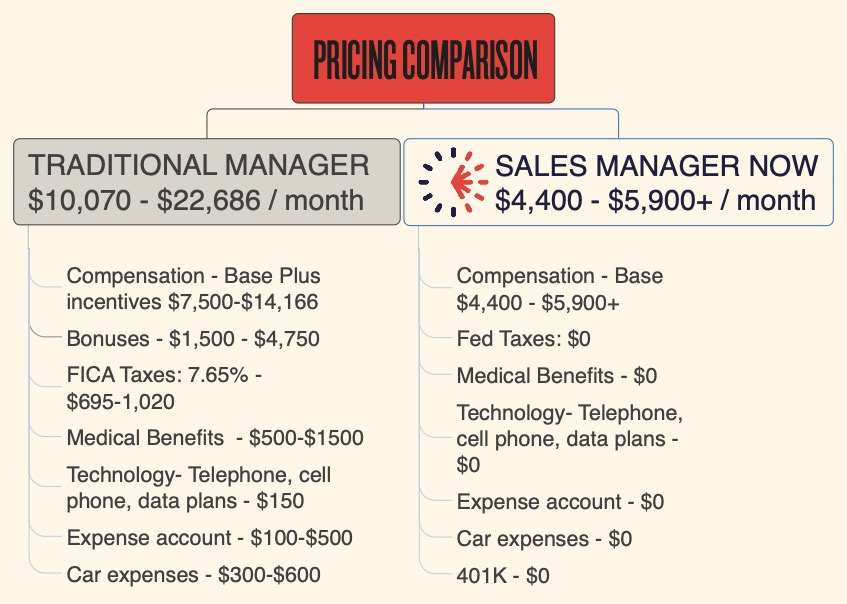
A common belief is that a professional sales manager’s compensation is a hurdle to overcome, but we have not found that to be the case. Compensation buys things but does not replace the challenges missing in most small business sales leadership roles. The fractional sales manager model solves the management void and does it cost-effectively. Paying less buys you more in this case. Depending on your long-term goals a fractional sales manager might be a bridge to a full-time sales manager or your long-term solution. We’ve had several clients keep us on board for over seven years. Here is a cost comparison between a full-time and fractional sales management approach.
Are you still wondering if fractional sales management is for you? As important as understanding what fractional sales management is, understanding what it’s not could also help your decision.
What Fractional Sales Management Is Not
Many sales consultants, coaches, and trainers serve the small business sales team community. They also share their time with multiple clients. Sales consultants generally focus on processes, systems, hiring, and coaching. They work to fix strategies to help the company better manage its team. Coaches often focus on sales techniques, messaging, and conversations, and trainers teach sales methodology. These are general descriptions; some will combine each discipline in their delivery. The big difference is in the following three areas.
- Consultants and coaches do not lead and manage the salespeople.
- Consultants and coaches rarely hire or manage employee dismissals.
- Consultants and coaches are not accountable for the assigned goals.
- Consultants and coaches don’t become part of a company’s management team.
Some fractional sales managers can perform some or all of the roles of coaches and consultants or contract them as needed. In addition, some fractional sales managers work with professional service provider who need a manager to keep them accountable and help them overcome the stigma of selling.
How to find the right fractional sales leader
Evaluating and contracting with a fractional sales leader differs from hiring an employee. A fractional leader is focused and accountable to results rather than time. While there will be some time commitments for meetings, getting in step, or tuning up, you are not buying hours of their time. You are investing in the results and outcomes described previously. Here are some factors to consider.
Relevant Sales Leadership Experience and Industry Knowledge: Ten or more years of sales leadership and management experience is a good benchmark. The term “sales manager” can refer to either a sales role or a management position. Be sure to clarify their experience during your interview. I look for twenty years of leadership experience when hiring my team of fractional sales leaders.
Industry experience becomes more critical if you require a new strategic direction sooner rather than later. Industry knowledge is less important if your current processes have been working but need improvement.
Fractional Sales Leadership Experience: The fractional industry is still relatively new. Anyone can be called a fractional manager or leader today. How they lead and manage and what they deliver is another story.
Understanding how many clients they have worked with is a fair question, as is asking whether they have a detailed process beyond simple title stages. Have them describe what transpired at past clients to help you discern their experience. A great question people ask me is: “When did things not work and why?”
Their website, YouTube channel, or LinkedIn presence should also tell you whether they are just getting started or are experienced in this role. Written articles or blogs are another way to evaluate their leadership approach.
Balance of Strategic Vision and Tactical Skills: When hiring a small-business fractional sales leader, it is essential to strike a balance between strategic vision and tactical skills. As described earlier, finding someone who has sales leadership and sales management skills is a great find.
Leadership Style and Cultural Fit: Evaluating leadership style and cultural fit will be similar to your current employee hiring process. It’s hard to know without checking references or working together. You are interviewing a salesperson, so remember you can easily be sold, so go slow and be sure.
Ask them what their process is when working with a new team. How they describe this process will tell you something about their leadership style. They might be winging it and relying on their personality if they are general or lose you in their explanation. If they have a proven process that is logical, documented, and easy to understand, it tells you they welcome accountability.
To assess cultural fit, invite another leader or partner onto a call to gain more perspective. Some clients are concerned the team might not accept us. In a case like this, we encourage them to schedule a meeting with us and allow us to have a Q and A with the team so they also get a sense of our fit and understand our approach. A fractional should be comfortable with a meeting like this before contracting.
Is Fractional Sales Management a Good Fit For You and Your Culture?
We’ve had several clients who have kept us on board for over seven years, and other times, we have helped for three months. We often stay engaged with a client based on how well our approach will fit a company’s culture and current management approach. If you think you might want to go down the road of hiring a fractional sales manager, the following list could help you decide if this approach would be a fit for you and your company culture. The checklist below is what our company has experienced for clients with tremendous success in leveraging fractional sales management.
- You want and are willing to change to grow the business. Growing sales is more than changing a sales team; it usually takes change from others, including owners.
- Owners with a more trusting leadership approach succeed more since a fractional sales manager is not in the office full-time.
- Your company has proven success with a sales team and process. Maybe your processes have not been the best, but they have brought the business to the current level of success. It confirms the market is there, and improvements should result in more sales. Startups are riskier if your proof of business plan has not been proven.
- A team of 2 or more salespeople so you can find some early gains and trust the process.
- Have or are willing to develop a current business plan to provide your fractional sales manager and the sales team with your clear vision and strategies. The plan fuels us to work toward your vision.
- Comfort with the fractional sales manager not being the product expert and committed to providing the sales team’s product or service knowledge to win business. Most fractional sales managers provide expertise in leading and managing salespeople, not product expertise.
- Attend some sales meetings to support the overall process.
- Willing to provide the technology tools the sales team will need to be successful and support the process and systems.
- They want this to work and hope for a long-term working relationship.
How Do You Hire a Fractional Sales Manager?
Once you’ve found a fractional sales manager, the hiring process is a blend of how you hire an employee and evaluate a service. When hiring an employee, you should determine if the candidate will fit your team and culture well and have the skills required to perform well. When evaluating a service, you should look at its proven process (how they approach Fractional Sales Management) because managing fractionally differs from working full-time. The last factor is to discern if the manager is asking questions to evaluate a good fit for their service or convincing you that you’d be lost without them. An experienced fractional sales manager understands that their approach will not work at all businesses and is confident that it will work with the right fit. Once you’ve made a selection, the manager should provide references.
Ideally, you should contract with someone who you hope will be a long-term solution or help you reach the stage of needing a full-time sales manager.
If you’d like to interview us at Sales Manager Now, it’s as easy as choosing a time below. If you are not ready for that, consider spending five minutes completing our Sales Management Assessment to get a sense of your current sales management approach’s strengths and weaknesses.